

『Recycled Oil Flow Meter Filtering Loop Wear Detection Rules』Related information(v cone flow meter|rotary gas meter|gallon meter|gear meter|metal tube rotameter|glass tube rotameter|nutating disk meter|transit time ultrasonic flow meter|wedge flow meter|pd meters|hydraulic flow meter|ultrasonic water flow meter|water flow meter|air flow meter|magnetic water flow meter|oxygen flow meter|gas flow meter|argon flow meter|air velocity meter|gasoline flow meter|fuel flow meter|ultrasonic water meter|digital water meter|nitrogen flow meter|solid flow meter|Oxygen tank flow meter|digital water flow meter|diesel fuel flow meter|steam flow meter|02 flow meter|compressed air flow meter|oil flow meter|liquid flow meter)
 ```html
Recycled Oil Flow Meter Filtering Loop Wear Detection: Direct Rules from Our Field Data
Quick Answer: For recycled oil filtering loops, you monitor wear by tracking minimum flow stability, differential pressure drift, and sudden viscosity shifts. A Coriolis meter with density output catches abrasive particle buildup 3 to 5 days before a filter bypass alarm triggers. The killer combination on real sites is a DN15 Coriolis plus a 4-20 mA HART transmitter sending live kg/h and kg/m³ to a loop powered indicator with a relay set at -8% from baseline flow.
Why Most Filter Loop Flow Meters Miss Wear Until It Is Too Late
We have seen this on customer sites many times. A gear pump pushes 40 °C recycled oil through a 50 micron filter. The operator checks pressure drop once a shift. Everything looks normal. Then a pump seal fails on a Friday night. The root cause is usually filter bypass or internal pump wear, and the flow meter style they picked could not show the slow change.
Many plants still use a simple turbine meter, or no meter, on the recycle line. These meters often survive only a few months. The recycled oil in a hydraulic press loop, for example, carries fine metal particles after stamping. These particles wear the turbine bearings. The signal drops out. The control system sees zero flow and locks the process. You lose a batch and maybe a customer.
In practice, the real problem is not the oil itself. The problem is what the oil carries. Abrasive particles collect in the filtering loop. They concentrate at bends, inside gear pumps, and around the filter housing. This creates a measurement trap. If your meter is downstream of the filter, it sees low velocity and gets coated. If it is upstream, it gets sandblasted. Most engineers skip this part during the first spec. They assume any flow meter rated for oil will work.
Wear Detection Starts with Density, Not Just Flow
Here is the thing. Flow rate alone tells you nothing about wear. A positive displacement meter like an oval gear can seize because of a single steel chip. A vortex meter will read high for a while, then the bluff body erodes and the K-factor shifts. By the time you see the error, the damage is done.
We solved this for a lubricant blending plant in Thailand. The customer was recycling used engine oil through a filtration loop. They ran the loop at 2000 kg/h with a setpoint tolerance of 3 percent. The plant manager wanted early warning of filter bypass. We proposed a DN15 Coriolis mass flow meter positioned upstream of the 20 micron bag filter. The meter outputs live mass flow in kg/h and density in kg/m³. The oil density at 40 °C was 872 kg/m³ with a viscosity of 32 cSt. After 11 days of continuous filtration, the density dropped to 868 kg/m³ and flow crept up by 2 percent. That tiny shift meant the filter was starting to bypass and unfiltered oil with suspended solids was mixing back into the clean tank.
They caught it during a planned shutdown. The filter element was torn along the seam. Without the density monitoring, they would have run another 10 days and damaged a high speed spindle bearing worth more than the flow meter itself.
Key Signals for Wear and Clogging in Recycled Oil Loops
Based on installations at hydraulic oil recycling systems, metal quenching oil circuits, and engine oil filtration skids in Australia, Vietnam, and Nigeria, we set three wear detection rules.
First, a falling minimum flow value while the pump runs at fixed speed. This points to pump wear. The impeller or gear clearance opens up. The slip increases. The meter reports lower flow at the same motor current. For a gear pump, a 5 percent drop in discharge flow at constant backpressure is often enough to schedule a pump inspection.
Second, differential pressure drift with stable flow. If the flow holds steady but the pressure upstream of the filter rises 0.8 bar or more over two shifts, the filter is loading up. A clogged filter can burst and send a slug of debris downstream. A loop powered pressure transmitter with a local indicator gives the operators a trend they can read without a PLC. Many small sites in Ghana and the Philippines only have a pressure gauge. That gauge needle may move too slowly for a human to notice.
Third, sudden viscosity change without a temperature shift. If the oil temperature is steady at 45 °C but the kinematic viscosity derived from the Coriolis meter moves from 46 cSt to 55 cSt, you probably have heavy oxidation or cross contamination. This happens in quenching oil tanks where heat transfer oil leaks into the quench oil loop. The flow meter cannot see the invisible leak, but the density-viscosity relationship flags it.
Filtering Loop Meter Selection: Specific Numbers People Copy Wrong
A common mistake is picking a meter body material based on the clean oil. Recycled oil is not clean. It contains carbon fines from engine oil, scale from heat exchangers, and metal powder from bearing wear. So the meter must handle solid content up to 0.5 percent by volume without wearing out in four months.
For DN15 to DN25 lines, we recommend a
For larger lines, DN50 and above, a vortex meter with an integral temperature sensor works if the minimum flow stays above the Reynolds number cutoff. But never use a vortex meter where the oil viscosity exceeds 30 cP at operating temperature. The vortex shedding becomes irregular. The reading jumps around. You will get alarm fatigue and start ignoring the meter.
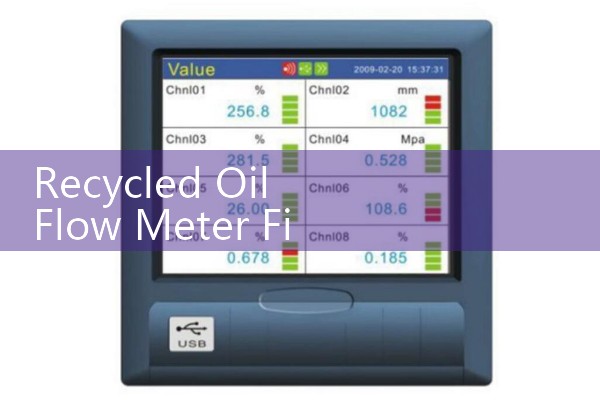
A simple loop architecture we use in West Africa for recycled oil skids: a DN15 Coriolis flow meter with 4-20 mA HART output, wired to a paperless recorder with a relay output. The recorder plots mass flow and density on the same trend screen in 1 minute intervals. The relay trips at 8 percent flow deviation from the 30-day rolling average. That average self-adjusts for seasonal temperature swings. The system runs on 24 V DC loop power, which is easy to maintain in remote sites with solar panels.
Installation Details That Prevent Early Failure
Because recycled oil can contain entrained air from the pump suction or return line splashing, we always insist on a minimum backpressure of 1.5 bar at the meter outlet. A Coriolis meter with entrained air will read low density and generate a diagnostic alarm. The alarm is useful, but you can avoid false trips by installing a simple air eliminator upstream or by raising the system backpressure with a spring loaded check valve.
Straight run is another topic where generic advice fails. For a vortex meter, the standard rule is 15D upstream and 5D downstream. In a compact filtration skid, you often do not have that space. A Coriolis meter needs no straight run. It fits right between the pump discharge and the filter inlet. That one feature cut the skid footprint by 400 mm for a hydraulic power unit builder in Dubai. The customer shipped 12 units per container instead of 10. Simple math paid for the meter upgrade.
Temperature compensation matters more than you think. Recycled oil heats up during the day inside a metal skid sitting under the sun in Lagos or Perth. A volumetric meter without temperature compensation will show a higher flow in the afternoon because the oil expands. The actual mass flow is the same. Use a meter with built in PT100 or a separate temperature transmitter feeding the flow computer for mass flow calculation.
FAQ: Recycled Oil Flow Meter Filtering Loop Wear Detection
Q: What is the cheapest flow meter for a small recycled oil loop?
A: If the oil is clean enough and viscosity is stable, an oval gear flow meter with a strainer upstream costing around USD 400 can work for DN10 to DN20. But budget for a spare set of rotors and a way to check flow stability weekly. Do not install it where solids exceed 0.1 percent.
Q: How do I detect filter bypass without density measurement?
A: Install two pressure transmitters, one before and one after the filter. Trend the differential pressure. A sudden drop while flow stays steady often means the filter element failed. It is a slower detection method but costs less than a Coriolis meter.
Q: Can I use a clamp-on ultrasonic meter on an oil filtering loop?
A: Rarely. The velocity needs to be above 0.5 m/s and the pipe wall must be clean. Used oil can form a varnish layer that kills the signal. Only try this if the pipe is new, schedule 40, and you can permanently mount the transducers with coupling compound rated for oil.
Q: What viscosity range stops a Coriolis meter from working?
A: None, practically. We have measured honey at 10,000 cP and hot oil at 2 cP with the same meter. The pressure drop increases with viscosity, so check that the meter body pressure rating matches the pump discharge. For very high viscosity, the meter size may need to be one size larger to keep pressure loss below 0.8 bar.
Q: How often do I need to recalibrate a flow meter on recycled oil duty?
A: A Coriolis meter typically needs a zero check every 6 months. No factory recalibration unless the tubes get coated. For an oval gear or turbine meter, check the K-factor against a master meter every 3 months if the oil is dirty. Send us your oil type, temperature in °C, pipe size (DN), and flow range in kg/h, and we will propose a meter and verification schedule.
Specific action: Send us your recycled oil temperature (°C), operating pressure (bar), pipe size (DN), achievable straight run length, and whether you need a local display or 4-20 mA output. We reply within one business day with a recommended meter model, material spec, and price for your country. For high
 Hot Product
 Related AD